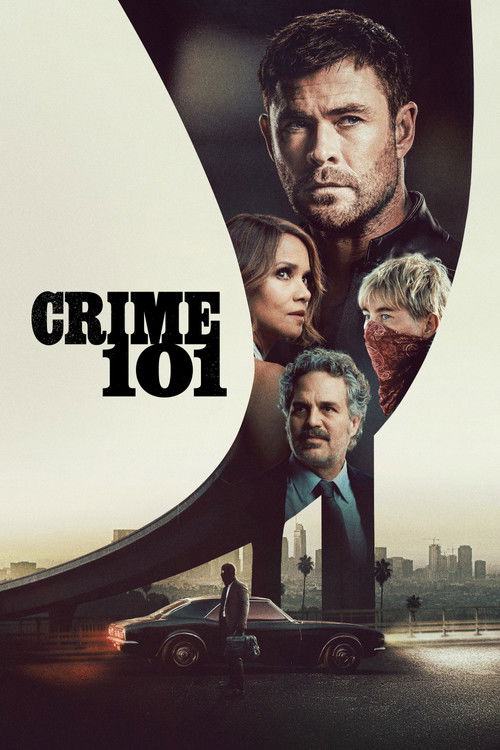
Crime 101 Review: A Heist Film That Outsmarts Its Own Genre
Most heist films live or die on the mechanics of the job. Crime 101 barely cares about the mechanics at all. That's either its defining strength or its most frustrating quality, depending entirely on what you walked in expecting — and the gap between those two reactions explains almost everything you need to know about this film.
Released on February 13, 2026, by Amazon MGM Studios, Crime 101 is written and directed by Bart Layton (The Imposter, American Animals), adapted from Don Winslow's slim 2020 novella. It stars Chris Hemsworth as a meticulous L.A. jewel thief, Mark Ruffalo as the tenacious LAPD detective tracking him, and Halle Berry as an insurance broker pulled into their orbit. The film earned positive reviews from critics but became a financial disappointment, grossing $71.9 million worldwide against a $90 million budget.
What the numbers don't tell you is this: Crime 101 is smarter and stranger than its marketing suggested. The harder question isn't whether it's good. It's whether it's the movie you think you're going to see.
QUICK ANSWER BOX Crime 101 (2026) is a crime thriller directed by Bart Layton, starring Chris Hemsworth, Mark Ruffalo, Halle Berry, and Barry Keoghan. Based on Don Winslow's 2020 novella of the same name, the film follows an elusive L.A. jewel thief eyeing one last score along the 101 freeway, a disillusioned insurance broker at a career crossroads, and the detective closing in on both. It holds an 88% approval rating on Rotten Tomatoes from 180 critics, and a score of 68 out of 100 on Metacritic, indicating generally favorable reviews. The film is rated R, runs 2 hours and 20 minutes, and is now streaming on Prime Video as of April 1, 2026.
KEY TAKEAWAYS
- Crime 101 premiered in London on January 28, 2026, and opened in U.S. theaters on February 13, 2026, before landing on Prime Video on April 1, 2026.
- The film is less a heist thriller and more four interlocking character studies — a distinction that separates its admirers from its detractors.
- Barry Keoghan's Ormon is widely cited as the film's scene-stealing wild card, despite the role being underdeveloped on the page.
- Filming took place in Pacific Palisades shortly before the January 2025 wildfires that affected parts of Los Angeles giving those L.A. night shots an unexpectedly elegiac quality in hindsight.
- The Heat comparisons are understandable but slightly misleading: Crime 101 isn't about two men who can't stop until they meet. It's about decent people deciding whether to break their own codes.
- Pedro Pascal was originally in talks to star alongside Hemsworth before dropping out due to scheduling conflicts with The Fantastic Four: First Steps.
- At 2 hours and 20 minutes, the film is around 20 minutes too long — a consensus criticism across nearly every review — but the extra time is spent deepening characters, not padding action sequences.
Table of Contents
- What Is Crime 101 Actually About?
- The Heat Comparison: Deserved or Lazy Shorthand?
- Chris Hemsworth Against Type
- The Real Stars: Ruffalo, Berry, and Keoghan
- Bart Layton's Direction and the Look of L.A.
- The Blanck Mass Score and Technical Craft
- The Pacing Problem (And Why It's Complicated)
- The Ending Explained
- Is Crime 101 Worth Watching?
- FAQ
What Crime 101 Is Actually About (Hint: It's Not the Heist)
Crime 101 is based on Don Winslow's 2020 novella, and the source material appeared in a collection called Broken — which turns out to be a handy clue to what makes the movie interesting. Davis, Lou, and Sharon are all wounded, essentially decent people who follow specific personal codes. The world around them has stopped caring about those codes. The film is about what happens when that collision becomes unavoidable.
Davis, raised as a foster child, is trying to construct an ordered world for himself. That's why he's such a cautious thief, controlled to a fault. He never harms anyone. He plans for months. He breaks with his fence Money over one job he considers too risky. This isn't a man who loves crime — it's a man who found a discipline that makes him feel in control of something.
Lou, played by Ruffalo as the Last Honest Cop in L.A., represents a department that has become a corporation, where the pressure to close cases drives colleagues to solve crimes at any cost. He's viewed by peers as a relic. His long-term girlfriend leaves him. He's principled in a city that treats principle like a liability.
Sharon, meanwhile, has spent over a decade at an insurance firm, is the only woman on staff of any significance, and is on track to become a full partner — only to find her bosses believe female agents "age out" because wealthy male clients only want to deal with younger women.
Three parallel stories of institutional betrayal, wearing the clothes of a heist film. That's the actual movie.
The Novella Problem
Here's the tension most critics circled without naming directly: Winslow's source material is roughly 50 pages long. Layton stretches it to 140 minutes. The screen adaptation unfolds a little more as each page turns, and in an effort to ensure audiences "get" it all, Layton does too much, seemingly uncertain whose story this really is and who he wants viewers to root for in the end.
That's a real structural issue. But it also produces a film with more interior life per character than almost any thriller released in 2026.
The Corrupt World Each Character Inhabits
What unifies the three leads isn't the heist — it's that each one confronts how broken their professional world really is and has to decide whether to do some breaking of their own. Ask yourself: when did a crime film last spend that much effort making you understand why its characters have reached a crossroads, rather than just showing you what they plan to steal?
The Heat Comparison: Deserved or Just Lazy Shorthand?
Every review of Crime 101 mentions Heat. Both are set in Los Angeles, both involve one last big score, both feature a thief semi-distracted by love, and both have a cop with a troubled life trying to apprehend the perpetrators. The comparison is structurally accurate. But it flattens what Layton is actually doing.
Chris Hemsworth's Mike Davis is essentially Robert De Niro's Neil McCauley, but minus a crew and significant firepower — because Mike works solo and doesn't like to use violence. That restraint is the point. Mann's thief was cool because he was dangerous. Layton's thief is interesting because he actively tries not to be dangerous, and the world around him keeps threatening to make him one anyway.
The moody synth score from Blanck Mass, the nocturnal cinematography, the patient standoffs — they all read as Mann adjacent. Sometimes it works. Sometimes it just feels too much like imitation. The honest answer is: Crime 101 earns comparison to Heat in craft and ambition, but it's reaching for something closer to Elmore Leonard in tone — it glistens with a silver-lined optimism you don't find in Mann's work, one closer to the hopeful pragmatism of Leonard's best crime fiction.
Quick Tip: If you go in expecting Heat's cold operatic grandeur, you'll be disappointed. If you go in expecting a smart character study with two exceptional car chases, you'll leave satisfied.
Chris Hemsworth Against Type
The most surprising thing about Crime 101 isn't the ending. It's that Hemsworth gives a genuinely interior performance in a role that offers him no superhero armor to hide behind.
He plays Mike as a more introverted thief, and while viewers can appreciate the attempt, he never fully disappears into the role — you still see the movie star beneath. That's a fair criticism. But it misses what he gets right. Hemsworth is physically disciplined here in a different way than Marvel trained him to be: careful, compressed, permanently alert. Watching his jittery introvert unravel under pressure, desperately trying to hold things together, proves his acting chops are sharper than people give him credit for.
The accent occasionally slips. A few scenes lean too hard on his natural charisma rather than earning quiet. But this is still the most interesting work he's done in years — and that's not a backhanded compliment.
The Real Stars: Ruffalo, Berry, and Keoghan
Mark Ruffalo does the most with the least showiest role. Doughy and unshaven, with an unfashionable mound of gray-black curls, he plays Lou as a knight with grizzled integrity — a quality his colleagues treat as a losing personality trait rather than a virtue. The corruption around him isn't cartoonish. It's bureaucratic. That's more unsettling.
Halle Berry has been selective about her roles this decade, and while she's capable of much more than what's asked of her here, she's nevertheless the best thing on screen for long stretches of the film's runtime, doing more with the material than one would expect. Her Sharon is quietly furious in the right way. The film underserves her in the third act — a near-universal complaint — but her presence in the middle hour is the film's emotional anchor.
Barry Keoghan as Ormon: Scene Stealer or Wasted Talent?
This is the genuinely contested question. Ormon is, ultimately, a throwaway role in service of the larger plot — but in Keoghan's hands, he's a tightly wound ball of frenetic energy, eyes darting, leaving viewers curious about what's actually going on in that brain of his.
The part most reviews skip: Keoghan makes Ormon feel like a complete person despite having almost no backstory. That's a craft achievement, not just a personality tick. His convenience store scene has been widely cited as the film's most memorable single moment — and it's a scene that exists almost entirely in his face.
The honest criticism is that Layton wrote Ormon as a plot device and Keoghan performed him as a human being. The gap between those two things is both the film's most interesting creative tension and a sign of a script that needed another draft.
Bart Layton's Direction and the Look of L.A.
Layton made his name with The Imposter (a documentary so strange it reads like fiction) and American Animals (a heist film that interrogated how we mythologize crime). Crime 101 is his first pure fiction feature, and it shows — but mostly in interesting ways.
Most of the film takes place at night, and Layton captures the gritty radiance of Los Angeles from high shots looking down on packed, floodlit freeways, through to close-ups of a motorcycle helmet acting as a quasi-mirror.
The two car chases are exceptional. They feel grippingly unchoreographed, as if the drivers really were figuring out at the last moment where to turn next. In a genre full of digitally polished action sequences, that improvisational quality is genuinely rare.
Where Layton's documentary instincts serve him best is in the small behavioral details. A character removes colored contact lenses in an early scene. It's never mentioned again. But it tells you everything about how Mike thinks. That kind of trust in visual storytelling lifts Crime 101 above its occasionally creaky dialogue.
The Blanck Mass Score and Technical Craft
Blanck Mass's pulsating score and the sparse but well-staged action set pieces — one during the opening daylight pursuit, the other a nighttime chase between Mike's car and Ormon's motorcycle — are highlights of the film's technical construction.
The score works because it never announces itself. It rises at exactly the right moments and disappears when the silence between characters is doing heavier work. It's synth-forward without being retro-costume — it sounds like a city at 2 a.m., not like a genre reference.
Common Mistake: People expecting Blanck Mass's score to sound like their electronic music work will be surprised. For Crime 101, they wrote something more restrained and atmospheric — less propulsive, more corroded.
The Pacing Problem (And Why It's Complicated)
Here's the honest complexity that most reviews either overstate or understate: the film's length is a real issue and also kind of the point.
At two hours and twenty minutes, the film feels longer than it needs to be, and several scenes could have been tightened or trimmed — but it's never boring, just lingers in places where it didn't have to.
But what gets cut if you tighten it? Maya's first date with Mike, which explains why he wants out. Lou's bathroom argument, which tells you everything about how the institution has worn him down. Sharon's sleep-tracking app, checking "poor sleep" every morning — a one-second joke that works as a portrait of a life measured by output. This smart crime thriller uses its extra running time to deepen its main characters and make their actions mean something.
A leaner version would be crisper. It would also be shallower. You have to decide which you want.
The Crime 101 Ending Explained
Full spoilers below.
The ending delivers a surprisingly hopeful resolution to a story built on moral compromise and institutional corruption. The pivotal moment arrives when Detective Lubesnick, who has spent the entire film hunting Mike, chooses to let him escape.
Why? Because Mike kills Ormon to save Lou's life a moment that forces the detective to confront the difference between a careful professional and a genuine menace.
In a move that contradicts his own earlier frustrations with police corruption, Lou covers for Mike by claiming Ormon was the elusive "101 bandit" all along, quietly threatening the slippery Steven Monroe to keep the secret buried. Lou steals real diamonds from the evidence case and passes them to Sharon, giving her the exit she's been denied. Mike walks free, empty-handed but alive.
It's a happy ending for everyone who didn't deserve one, handed out by the one honest cop who had spent two hours refusing to bend. That's either a beautiful irony or an unsatisfying compromise, depending on your reading. The film earns both interpretations without forcing one.
Is Crime 101 Worth Watching?
Yes — with one condition. You need to know what you're signing up for.
It's so rare to see studios bother with a well-plotted, crisply orchestrated crime picture that the film feels like a gift, as one reviewer put it. That's the right frame. Crime 101 is an adult thriller made with genuine craft at a scale Hollywood rarely bothers with anymore. It has two of the best car chases in recent memory, four performances worth watching closely, a score that earns every scene it underscores, and a ending that trusts you to sit with its ambiguity.
What it isn't: a reinvention of the heist genre, a tight 100-minute thriller, or a film that fully resolves every subplot it opens. That Crime 101 comes close to greatness and never quite gets there is not a crime. Even if it was, it'd be a misdemeanor.
My rating: 7.5/10
FAQ
Is Crime 101 based on a true story? (Search autocomplete)
No. Crime 101 is adapted from a fictional novella by crime author Don Winslow, published in 2020 as part of a collection called Broken. The characters and heist plot are invented, though the film uses authentic Los Angeles locations along the real U.S. Route 101 freeway, which serves as both the thief's escape route and the source of the film's title.
How does Crime 101 end? (PAA)
In the final act, Mike shoots the unhinged criminal Ormon to save Detective Lou Lubesnick's life. In return, Lou lets Mike walk free, frames Ormon posthumously as the "101 bandit," and quietly threatens the corrupt businessman Monroe to protect the cover story. Lou then gives Sharon the real diamonds, allowing her a fresh start outside the firm that had been slowly pushing her out. It's a morally complicated resolution that rewards three characters who all broke their own codes to survive a more deeply corrupt world.
Is Crime 101 better than Heat? (Reddit)
They're aiming at different targets. Crime 101 is more interested in why its characters are criminals than in the operatic tension of the cop-and-thief dynamic that defines Heat. Crime 101 can't match Heat — few films could — but as a standalone heist film, you could do a lot worse. If you want a colder, more relentless thriller, Heat wins easily. If you want something warmer in its ambitions and more interested in moral failure, Crime 101 makes its own argument.
Where can I watch Crime 101? (PAA)
Crime 101 premiered on Prime Video on April 1, 2026. It was previously a theatrical-only release from February 13, 2026, distributed by Amazon MGM Studios in the U.S. and Sony Pictures Releasing International internationally.
Why did Crime 101 flop at the box office? (Search autocomplete)
Crime 101 opened to $14.3 million in its debut weekend from 3,161 theaters, finishing third at the box office. Against a $90 million budget, the film's total worldwide gross of $71.9 million made it a financial disappointment. Adult-oriented crime thrillers without franchise attachment have struggled at the theatrical box office through the mid-2020s, and Crime 101 faced stiff competition in its opening weekend from Wuthering Heights and Goat.
Is Barry Keoghan good in Crime 101? (Reddit)
The role of Ormon is ultimately a bit of a throwaway, in service of the larger plot — but in Keoghan's hands, he becomes a tightly wound ball of frenetic energy with unique mannerisms, leaving viewers curious about what's going on in that brain of his. His convenience store scene in particular has become one of the film's most-discussed sequences. The consensus is that Keoghan overdelivers on underdeveloped material — which is exactly the kind of performance that sticks with you after a film ends.
Who composed the Crime 101 score? (PAA)
The score was composed by Blanck Mass, the electronic music project of Benjamin John Power. The pulsating score complements the film's well-staged action set pieces, though Blanck Mass worked in a more restrained, atmospheric register here than in their standalone releases. The result is a synth score that functions like ambient pressure — present throughout without overwhelming the character scenes.
Is Crime 101 too long? (Search autocomplete)
At two hours and twenty minutes, the film feels longer than it needs to be, and cutting it to just under two hours would likely have made it a stronger film — but it's never boring, just lingers in places where it didn't have to. The length reflects Layton's decision to prioritize character texture over plot momentum. Viewers who value depth over pace will forgive the runtime; genre fans expecting a lean thriller may not.
What the 101 Actually Teaches You
Start here: Crime 101 isn't a film that rewards impatience. The robbery plot is almost beside the point. What Bart Layton built is a slow portrait of three people who still believe in something — and the moment when that belief collides with a city that stopped caring.
Ruffalo's detective is the beating heart of this film, not Hemsworth's thief. Once you see that, the ending stops feeling too easy and starts feeling earned. The Last Honest Cop commits his one dishonest act to preserve the only thing in the film that resembles real justice. That's the whole movie in a single decision.
Berry is criminally underused in the third act, the pacing sags around the 90-minute mark, and Hemsworth's star wattage never quite extinguishes enough for you to fully believe the character. These are real flaws.
But Crime 101 is still a film that treats its audience as adults, casts actors who actually act, and shoots Los Angeles like a city worth caring about. In 2026, that should count for more than it does at the box office.
Watch it on Prime Video tonight. Give it 20 minutes before you decide.
It's the kind of ordinary movie we used to take for granted. That's the highest compliment you can give it.
Links:
- Crime 101 on Rotten Tomatoes — critical consensus and audience scores
- Crime 101 on Wikipedia — full production details and box office data
- NPR's Crime 101 Review — a thoughtful take on the film's old-fashioned sensibility
ABOUT THE AUTHOR
Muzamil Ahad is a digital content strategist and film writer based in Kashmir, with over a decade of experience building SEO-focused content for entertainment, tech, and culture platforms. He founded Web Design Kashmir, where he has worked with regional businesses to grow their digital presence, and has written extensively about cinema across platforms including Medium and Quora, where his film analysis pieces regularly reach engaged genre audiences. Muzamil approaches movie reviews the way a good detective approaches a case — looking past the surface consensus to find what a film is actually trying to say, and who it's really made for.
Connect with Muzamil: 🔗 LinkedIn: https://www.linkedin.com/in/muzamil-ahad/ 💬 Quora: https://www.quora.com/profile/MUZAMIL-AHAD-7 📘 Facebook: https://www.facebook.com/webdesignkashmir/ 📸 Instagram: https://www.instagram.com/kashmirwebdesigner/ ✍️ Medium: https://medium.com/@MUZAMIL-Ahad 🐦 X: https://x.com/WebDesignJandk
📌 Pinterest: https://www.pinterest.com/MUZAMIL_AHAD/